The world of data storage is undergoing a revolutionary transformation, moving from silicon to biology. In a groundbreaking development, scientists have successfully created the first operational biological molecular data center, utilizing DNA as its primary storage medium. This unprecedented achievement marks a pivotal moment in the history of information technology, potentially solving some of our most pressing data storage challenges while opening doors to entirely new possibilities.
DNA storage technology has long been theorized as the ultimate solution for humanity's exponentially growing data needs. Where traditional data centers require football-field-sized facilities consuming massive amounts of energy, DNA offers the potential to store all the world's information in a space no larger than a sugar cube. The newly unveiled biological data center represents the first practical implementation of this visionary concept at an industrial scale.
What makes this development particularly remarkable is its timing. Just a decade ago, DNA data storage existed only as laboratory experiments with miniscule capacity. Today, researchers have overcome numerous technical hurdles to create a functional system capable of enterprise-level data storage and retrieval. The center currently operates with petabyte-scale capacity, with plans to expand to exabyte levels within three years.
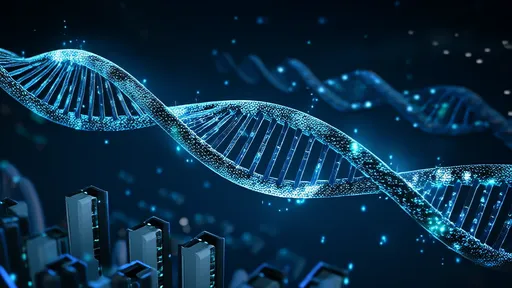
The architecture of this biological data center differs fundamentally from conventional facilities. Instead of racks upon racks of hard drives or solid-state storage, the system uses specially designed biochemical modules that store information in synthetic DNA strands. These modules maintain precise environmental conditions to preserve the DNA molecules while allowing for both writing and reading operations. Advanced microfluidics systems handle the movement of DNA samples between storage and processing units.
Data encoding in DNA follows a sophisticated biological protocol. Digital information gets translated from binary code into the four-letter alphabet of DNA bases (A, T, C, G). Special algorithms ensure error correction and efficient packing of data within the molecules. When information needs to be retrieved, the system sequences the relevant DNA strands and decodes them back into digital format. The entire process, while complex, has been optimized to work at speeds approaching practical business requirements.
The implications for data longevity are staggering. Where traditional storage media degrade over years or decades, properly preserved DNA can maintain data integrity for centuries or even millennia. This makes the technology particularly attractive for archival purposes, where long-term preservation is paramount. Several national archives and cultural heritage organizations have already expressed keen interest in adopting the technology.
Energy efficiency stands as another major advantage of molecular data storage. Current estimates suggest DNA-based systems consume about 90% less energy than conventional data centers performing equivalent work. In an era of growing environmental concerns and energy constraints, this benefit alone could drive rapid adoption across industries seeking to reduce their carbon footprints while maintaining data capacity.
The security aspects of DNA data storage present both opportunities and challenges. On one hand, the physical nature of DNA storage makes traditional cyberattacks impossible—you can't hack molecules over a network. On the other hand, the system requires entirely new approaches to data protection and access control. Researchers have developed novel encryption methods specifically designed for biological data storage, including techniques that leverage DNA's own biochemical properties.
Industry analysts predict that DNA storage won't replace conventional systems entirely but will instead carve out specialized niches. Cold storage applications—where data needs to be preserved but isn't frequently accessed—represent the most immediate use case. As the technology matures, we may see hybrid systems emerge that combine the speed of electronic storage with the density and longevity of biological solutions.
Several major tech companies have already begun positioning themselves in this emerging market. While the current biological data center represents an academic and government-backed initiative, private sector involvement is growing rapidly. Investment in DNA storage startups has increased tenfold over the past two years, with some industry veterans predicting this could become a trillion-dollar market by the 2040s.
The road ahead for DNA data storage still contains significant technical challenges. Writing speeds need improvement to compete with conventional storage for active datasets. Error rates, while manageable, require further reduction for certain critical applications. And the overall system cost remains prohibitive for most organizations, though it's dropping faster than many experts anticipated.
Perhaps most fascinating is how this development blurs the line between biology and information technology. We're witnessing the birth of an entirely new category of infrastructure that merges principles from computer science, molecular biology, and materials science. The researchers behind this project describe their work as "teaching biology to speak the language of information" and "bringing information technology into the molecular age."
As the first biological molecular data center comes online, it serves as both a practical achievement and a symbolic milestone. It demonstrates that alternatives to traditional digital storage not only exist but can be implemented at meaningful scales. While questions remain about timelines for widespread adoption and specific applications, one thing is certain: the future of data storage will be written in the letters of the genetic code.
The successful operation of this facility suggests that DNA storage may transition from laboratory curiosity to commercial reality much faster than anticipated. Early adopters in fields like scientific research, film preservation, and historical archiving are already testing the technology with promising results. Within the next decade, we may see DNA storage become a standard option in the data center industry's portfolio of solutions.
Looking further ahead, the implications extend beyond mere data storage. The ability to reliably encode and retrieve information from biological molecules opens possibilities we're only beginning to imagine. Some researchers speculate about future systems where biological and electronic computing elements work in tandem, creating hybrid information ecosystems unlike anything that exists today.
For now, the focus remains on perfecting DNA as a storage medium. Each passing month brings improvements in density, speed, and reliability. The team behind the world's first biological molecular data center continues to refine their systems while exploring new applications for the technology. Their work represents not just an engineering achievement, but a fundamental reimagining of what data infrastructure can be.
As we stand at this technological crossroads, one thing becomes increasingly clear: the marriage of biology and information science will shape the next chapter of our digital future. The age of molecular information has begun.
By /Jul 28, 2025
By /Jul 28, 2025
By /Jul 28, 2025
By /Jul 28, 2025
By /Jul 28, 2025
By /Jul 28, 2025

By /Jul 28, 2025
By /Jul 28, 2025

By /Jul 28, 2025
By /Jul 28, 2025

By /Jul 28, 2025
By /Jul 28, 2025

By /Jul 28, 2025
By /Jul 28, 2025
By /Jul 28, 2025

By /Jul 28, 2025
By /Jul 28, 2025

By /Jul 28, 2025

By /Jul 28, 2025

By /Jul 28, 2025