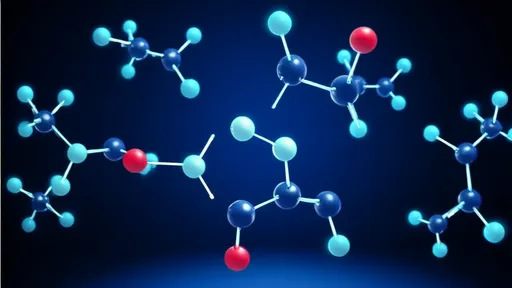
The discovery of amino acids in meteorites has long tantalized scientists with the possibility that the building blocks of life may have extraterrestrial origins. Among the most intriguing aspects of these findings is the observed chiral bias in these organic molecules—a phenomenon that could hold clues to the emergence of life beyond Earth. Unlike the racemic mixtures typically produced in abiotic synthesis, certain meteoritic amino acids exhibit a slight excess of one enantiomer over the other, mirroring the homochirality essential to life as we know it.
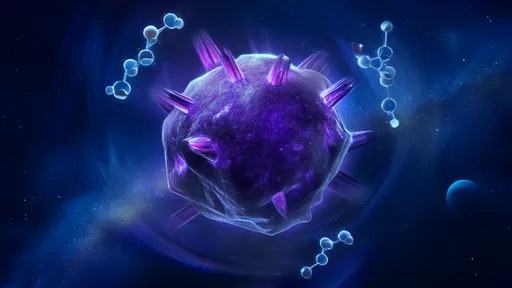
Chirality, or handedness, is a fundamental property of organic molecules. Amino acids, for instance, can exist in left-handed (L) or right-handed (D) forms. On Earth, life overwhelmingly uses L-amino acids for protein synthesis, a preference whose origins remain debated. The detection of L-enriched amino acids in carbonaceous chondrites, such as the famed Murchison meteorite, raises profound questions: Could this bias have been seeded from space? Or does it reflect processes that occurred after Earth's formation?
Recent analyses of pristine meteorite samples have strengthened the case for an extraterrestrial chiral bias. Researchers using advanced chromatography and mass spectrometry techniques have consistently found small but significant L-excesses in certain amino acids, particularly those with structural complexity. These findings suggest that asymmetric synthesis or destruction mechanisms—possibly influenced by polarized light or other chiral forces in space—may have operated before these compounds reached Earth.
The implications for astrobiology are far-reaching. If chiral molecules were delivered to early Earth via meteorites, they could have provided a head start for the emergence of biological homochirality. Some researchers propose that even a modest initial bias might have been amplified through prebiotic chemical networks, ultimately leading to the exclusive use of one enantiomeric form by living systems. This scenario would position meteorites not merely as carriers of organic material, but as potential contributors to life's foundational asymmetry.
However, alternative explanations caution against overinterpretation. Terrestrial contamination remains a persistent concern, though rigorous protocols for handling meteorite samples have minimized this issue. Others argue that aqueous alteration on the meteorite parent bodies—asteroids or protoplanets—could have induced chiral biases through mechanisms like crystallization or adsorption onto chiral mineral surfaces. Distinguishing between these possibilities requires comparative studies of amino acids in different meteorite classes and laboratory simulations of extraterrestrial environments.
Beyond our solar system, the detection of chiral molecules in interstellar clouds adds another layer to the mystery. Radioastronomy has identified precursors to amino acids in molecular clouds, and some theories predict that circularly polarized starlight could induce enantiomeric excesses even before molecules become incorporated into planetary systems. Future missions analyzing pristine cometary material or the plumes of icy moons may provide crucial tests for these ideas.
The quest to understand meteoritic amino acid chirality exemplifies the interdisciplinary nature of origins-of-life research. It bridges cosmochemistry, analytical chemistry, and biology while challenging our definitions of life's prerequisites. As sample-return missions and more sensitive instruments come online, the coming decades may reveal whether the chiral signatures in these ancient space rocks are mere curiosities—or chemical fossils pointing toward a universal preference for life's handedness.
By /Jul 28, 2025
By /Jul 28, 2025

By /Jul 28, 2025
By /Jul 28, 2025
By /Jul 28, 2025
By /Jul 28, 2025

By /Jul 28, 2025
By /Jul 28, 2025

By /Jul 28, 2025
By /Jul 28, 2025

By /Jul 28, 2025
By /Jul 28, 2025
By /Jul 28, 2025
By /Jul 28, 2025
By /Jul 28, 2025

By /Jul 28, 2025

By /Jul 28, 2025

By /Jul 28, 2025

By /Jul 28, 2025

By /Jul 28, 2025