The discovery of microplastics in ancient ice cores has fundamentally altered our understanding of pre-industrial pollution. For decades, scientists assumed that plastic contamination was a purely modern phenomenon, a byproduct of post-1950s mass production. Yet recent analyses of ice layers dating back to the 18th century reveal faint but undeniable traces of synthetic polymers. These findings force us to reconsider not just the timeline of anthropogenic impact, but the very definition of "pristine" environments.
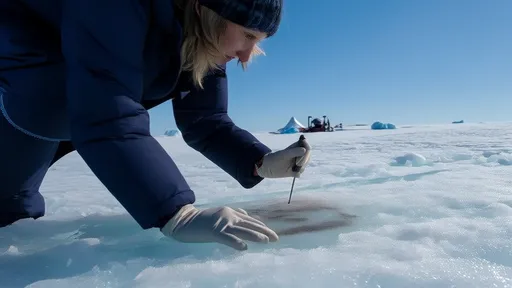
Glacial archives tell an unexpected story. When researchers first drilled deep into alpine glaciers, they expected a clean record of atmospheric composition before the Plastic Age. Instead, mass spectrometry detected polyethylene terephthalate fibers in ice formed during the Napoleonic Wars. The particles were sparse—perhaps one fiber per liter of melted ice—but their presence was irrefutable. These minuscule artifacts suggest that early industrial processes, particularly textile manufacturing and coal combustion, may have released precursor compounds that later polymerized in the atmosphere.
The implications ripple across multiple disciplines. Climate models that treat pre-1900s air pollution as purely organic may require adjustment. The detection of century-old microplastics in Greenlandic ice sheets, thousands of miles from potential sources, demonstrates how these particles mimic the global dispersal patterns of volcanic ash or cosmic dust. What we once considered background noise in paleoclimate studies might actually be the first whispers of human-driven planetary change.
A forensic approach to historical pollution is emerging from these studies. By comparing ice core layers to industrial records, researchers traced a spike in 1780s plastic particles to the rise of mechanized cotton mills. The sizing agents used to strengthen thread—often natural resins blended with early synthetic compounds—appear to have shed microscopic debris into waterways and atmosphere. This challenges the narrative that microplastic pollution began with mid-20th century materials like nylon and PVC.
The ice preserves these particles with extraordinary fidelity. Unlike soil or sediment cores where plastics can migrate between layers, glacial chronology provides annual resolution. Researchers have identified distinct "plastic peaks" corresponding to the American Civil War's textile boom and the 1880s coal tar distillation boom in Europe. Each fiber serves as a physical timestamp of technological evolution, revealing how industrial innovations dispersed globally through the atmosphere before the era of globalization.
This rediscovery of pre-industrial microplastics forces a paradigm shift in environmental science. Regulatory frameworks defining "natural" background levels must now account for centuries of low-level synthetic accumulation. The finding also complicates biodegradation studies—if some polymers persist in glaciers for 200 years, their environmental half-life may exceed current estimates. Perhaps most unsettling is the realization that no living organism has existed in a plastic-free environment for at least ten generations.
The hunt for older plastics continues. Teams are now analyzing medieval ice from Norwegian glaciers and permafrost samples from Siberia. Preliminary evidence suggests cellulose nitrate—an early plastic used in Victorian-era photographic film—may exist in 17th century layers. As analytical techniques improve, scientists anticipate discovering even earlier examples of anthropogenic polymers, potentially pushing the timeline back to ancient times when natural rubber processing or asphalt use could have created similar microscopic residues.
This research carries profound philosophical weight. We can no longer view the pre-industrial atmosphere as a clean slate, nor assume that "natural" equates to "free from human influence." The microplastics embedded in centuries-old ice represent more than scientific curiosities—they are physical manifestations of humanity's long, complex relationship with materials. As glaciers continue to melt, releasing these archived particles back into active ecosystems, we're forced to confront an uncomfortable truth: the environmental baseline we've been trying to restore may have always contained the seeds of our synthetic age.

By /Jul 28, 2025

By /Jul 28, 2025

By /Jul 28, 2025

By /Jul 28, 2025

By /Jul 28, 2025

By /Jul 28, 2025

By /Jul 28, 2025

By /Jul 28, 2025

By /Jul 28, 2025

By /Jul 28, 2025
By /Jul 28, 2025

By /Jul 28, 2025

By /Jul 28, 2025

By /Jul 28, 2025

By /Jul 28, 2025

By /Jul 28, 2025

By /Jul 28, 2025

By /Jul 28, 2025
By /Jul 28, 2025

By /Jul 28, 2025