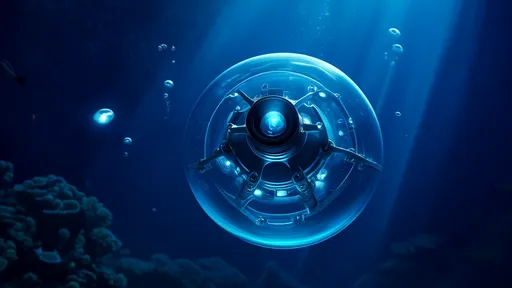
The vast expanse of the world’s oceans remains one of the most critical frontiers for scientific exploration and environmental monitoring. Yet, powering the sensors that collect this invaluable data has long been a challenge. Traditional battery-powered systems are limited by their lifespan and the logistical difficulties of replacement in remote or deep-sea environments. Enter the emerging field of self-powered marine sensors—a technological leap that could revolutionize how we study and protect our oceans.
Energy Harvesting Beneath the Waves
The concept of self-powered sensors hinges on the ability to harness energy from the surrounding environment. In the ocean, this energy can be drawn from multiple sources: the motion of waves, temperature gradients, salinity differences, or even underwater currents. Piezoelectric materials, for instance, convert mechanical energy from wave movements into electrical power. Similarly, thermoelectric generators exploit temperature variations between deeper, colder waters and warmer surface layers. These innovations eliminate the need for external power sources, enabling sensors to operate autonomously for extended periods.
Breaking Free from Battery Dependence
Conventional marine sensors rely on batteries that require frequent maintenance or replacement—a costly and often impractical endeavor, especially in deep-sea or polar regions. Self-powered systems circumvent this issue entirely. For example, a sensor deployed to monitor coral reef health can now draw energy from the subtle sway of ocean currents, transmitting data without human intervention. This autonomy is particularly crucial for long-term ecological studies, where consistent data collection over years or decades is essential to track environmental changes.
The Role of Advanced Materials
Recent advancements in material science have been pivotal in making self-powered marine sensors a reality. Flexible piezoelectric polymers can now withstand the corrosive saltwater environment while efficiently converting mechanical energy. Meanwhile, breakthroughs in triboelectric nanogenerators (TENGs) allow sensors to generate power from friction between materials—such as the movement of floating buoys or submerged equipment. These materials are not only durable but also scalable, paving the way for widespread adoption across research institutions and governmental agencies.
Applications Beyond Research
While scientific research remains a primary beneficiary, self-powered sensors have far-reaching implications for industries like offshore energy, shipping, and defense. Oil rigs could deploy these sensors to monitor structural integrity without the risk of power failures. Shipping lanes might use them to detect underwater hazards in real time. Even naval operations could leverage the technology for stealthy, long-term surveillance. The potential applications are as vast as the oceans themselves.
Environmental and Economic Synergy
Beyond functionality, self-powered sensors align with global sustainability goals. By reducing reliance on disposable batteries, they minimize hazardous waste in marine ecosystems. Economically, the long-term cost savings are substantial—fewer maintenance missions mean lower operational expenses. This dual benefit of environmental stewardship and fiscal efficiency makes the technology an attractive proposition for policymakers and industry leaders alike.
Challenges on the Horizon
Despite their promise, self-powered marine sensors face hurdles. Energy output can be inconsistent in calmer waters, and extreme depths may limit the effectiveness of certain harvesting methods. Engineers are addressing these issues through hybrid systems that combine multiple energy sources, ensuring reliability across diverse marine conditions. Standardization and data transmission in remote areas also require further innovation to achieve seamless integration into existing monitoring networks.
A New Era of Ocean Observation
As prototypes evolve into commercial deployments, the future of oceanography and marine conservation looks brighter. Imagine a global network of sensors, each silently drawing power from the sea itself, collectively painting an unprecedented picture of oceanic health. From tracking climate change impacts to preventing illegal fishing, self-powered sensors could become the unsung heroes of marine sustainability—proof that sometimes, the best solutions are those that work in harmony with nature.

By /Aug 26, 2025
By /Aug 15, 2025

By /Aug 26, 2025

By /Aug 26, 2025
By /Aug 15, 2025

By /Aug 15, 2025

By /Aug 15, 2025
By /Aug 15, 2025

By /Aug 15, 2025

By /Aug 15, 2025

By /Aug 26, 2025

By /Aug 15, 2025
By /Aug 15, 2025

By /Aug 26, 2025

By /Aug 15, 2025

By /Aug 15, 2025

By /Aug 15, 2025

By /Aug 15, 2025

By /Aug 15, 2025

By /Aug 15, 2025